

From Vehicles to Ecosystems: What Interoperability Really Means for Operations and IT Teams
- Emily Gregory

- Mar 24
- 4 min read
For years, automated guided vehicles were evaluated like equipment purchases. What does the vehicle do? How fast is it? How much does it cost?
But the AGV conversation has shifted.
Today, automation decisions aren’t just about a single vehicle or even a fleet. They’re about how systems connect, scale, and evolve over time. That’s where interoperability comes in, and why it’s becoming a shared concern for both Operations and IT teams.
Interoperability isn’t a buzzword. It’s a signal that AGV automation has moved from isolated solutions to connected ecosystems.
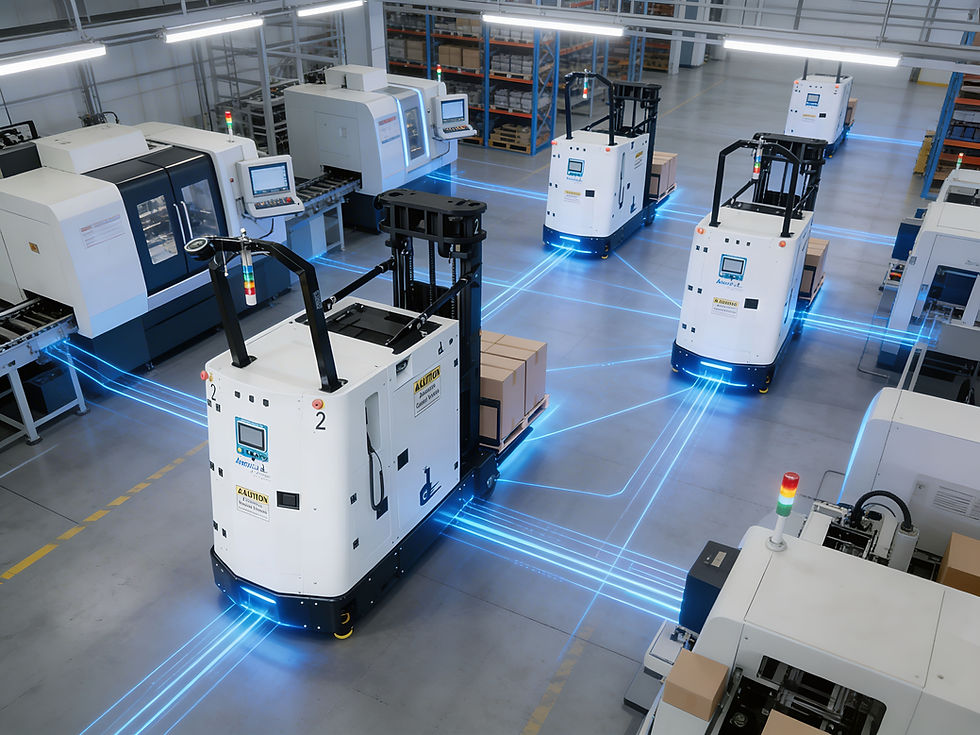
The shift: from buying vehicles to building ecosystems
Modern facilities are more dynamic than ever. Production volumes change. Layouts evolve. Software stacks expand. New equipment gets added, sometimes from different vendors, sometimes years apart.
In that environment, automation that works only within a closed system becomes a constraint instead of an advantage.
Interoperability is the ability for AGVs, fleet management software, and enterprise systems to communicate through defined interfaces rather than proprietary workarounds. Practically speaking, it means your automation isn’t locked into a single vendor or frozen in time.
Instead of asking: “Will this AGV work?” Teams are increasingly asking: “Will this system still work when our operation changes?”
That’s an ecosystem question.
Why interoperability matters to Operations
From an operations perspective, interoperability shows up in very tangible ways.
1. Scalability without disruption
When systems rely on open or standardized interfaces, expanding a fleet or adding new workflows doesn’t require ripping out what already works. Operations can grow capacity incrementally instead of starting over.
2. Reduced commissioning complexity
Interoperable systems reduce the amount of custom logic required to get vehicles, software, and controls working together. That means faster commissioning, fewer surprises, and less dependency on tribal knowledge.
3. Flexibility for real-world change
No operation stays static. Interoperability allows material flow strategies, routing logic, or vehicle roles to change without redesigning the entire system.
For ops teams, that flexibility translates directly to uptime, predictability, and resilience.
Why IT cares even when vehicles “aren’t their problem”
AGVs may live on the floor, but they increasingly touch the same digital backbone as the rest of the business.
Interoperability matters to IT because it affects:
System integration
AGV systems don’t operate in isolation. They exchange data with WMS, ERP, MES, and safety systems. Standardized interfaces reduce custom integrations and simplify long‑term support.
Security and governance
Clear interface definitions make it easier to apply security policies, manage access, and maintain visibility into system behavior.
Lifecycle management
Closed systems can create long‑term technical debt. Interoperable platforms are easier to update, monitor, and evolve alongside the rest of the IT environment.
For IT, interoperability isn’t about the robots — it’s about maintainability and control.
Standards, open interfaces, and what they actually signal
You may hear interoperability discussed in the context of industry standards or open interfaces. While the technical details vary, the underlying signal is consistent:
The market is acknowledging that customers don’t want to be boxed in.
Standards exist to reduce friction between vehicles and fleet management systems, especially in mixed‑fleet environments. They reflect a broader expectation that automation systems should be designed to coexist — not compete — inside a facility.
What matters most isn’t the name of a standard, but the philosophy behind it:
Clear interfaces
Transparent communication
Future flexibility
Those are ecosystem principles, not product features.
Interoperability and ROI: the long view
Interoperability rarely shows up as a line item on a quote, but it has a direct impact on long‑term return.
It influences:
How expensive future expansions become
How quickly changes can be implemented
How dependent you are on any single vendor
How easily knowledge transfers between teams
In other words, interoperability affects the cost of change — and change is inevitable.
Questions Ops + IT should ask before committing to an AGV system
Interoperability doesn’t require deep technical expertise to evaluate. It requires asking the right questions early.
A few worth starting with:
How does this system integrate with our existing software stack?
What happens if we add vehicles or change workflows in the future?
How dependent are we on proprietary tools or custom code?
What visibility and data access do we retain long‑term?
How involved will IT need to be during deployment and ongoing support?
Good automation partners welcome these questions. They design for them.
From vehicles to ecosystems — intentionally
At America in Motion, we see AGVs as part of a larger operational ecosystem, not standalone machines. That’s why system design, software architecture, and customer education matter as much as vehicle performance.
Interoperability isn’t about chasing trends. It’s about building automation that:
Adapts as your operation evolves
Supports both Ops and IT priorities
Remains an asset — not a constraint — over time
Because the real value of automation isn’t just what it does today. It’s how well it supports where you’re going next.

Planning an AGV project or system expansion? Let’s review your operation together and design an automation ecosystem that can grow with you. Click here to schedule a call with our team of AGV experts.


Comments